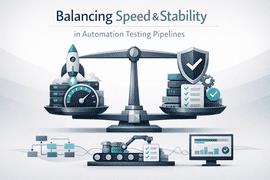




Balancing Speed and Stability in Automation Testing Pipelines

In modern development environments, teams are under constant pressure to release faster without compromising quality. From what I’ve observed across production systems, this tension often shows up most clearly in automation testing pipelines.
Teams want fast feedback from their pipelines, but they also need reliable results they can trust. Moving too far in either direction creates problems - pipelines become either slow and blocking, or fast but unreliable. The real challenge lies in finding the right balance between speed and stability.
Why Speed Alone Isn’t Enough
In many teams, the initial focus is on accelerating pipeline execution. Faster builds mean quicker feedback, which aligns well with Agile and CI/CD practices.
However, pushing for speed without considering stability often leads to:
- Flaky test results that developers begin to ignore
- Missed defects due to reduced coverage
- Increased debugging time caused by inconsistent failures
I’ve seen teams reach a point where pipeline results are no longer trusted, which defeats the entire purpose of automation.
Why Stability Without Speed Also Fails
On the other end, some teams prioritize stability by running large, comprehensive test suites on every commit. While this improves confidence in results, it introduces new challenges:
- Long pipeline execution times
- Delayed feedback for developers
- Reduced development velocity
In fast-moving environments, slow pipelines become a bottleneck, often leading teams to bypass or delay testing altogether.
What High-Performing Teams Do Differently
From observing production workflows, the most effective teams don’t treat speed and stability as trade-offs. Instead, they design their automation testing pipelines to support both through structured strategies.
1. Layered Test Execution
Rather than running all tests at once, teams distribute tests across layers:
- Fast unit and API tests run on every commit
- Integration tests run on merge or pre-release stages
- Full regression suites run on scheduled or nightly builds
This approach ensures quick feedback without sacrificing deeper validation.
2. Prioritization Based on Risk
Not all tests are equally valuable. High-performing teams prioritize:
- Critical business workflows
- Frequently changing modules
- Areas with a history of defects
By focusing on high-impact tests early in the pipeline, teams maintain both speed and meaningful coverage.
3. Managing Flaky Tests Proactively
Flaky tests are one of the biggest threats to pipeline stability. Teams that succeed treat flakiness as a priority issue, not a minor inconvenience.
Common practices include:
- Identifying and isolating unstable tests
- Fixing root causes instead of rerunning blindly
- Removing low-value or redundant tests
This ensures that pipeline results remain reliable and actionable.
4. Optimizing Test Data and Environments
Inconsistent environments and poor test data management often slow down pipelines and cause instability.
Teams improve this by:
- Using consistent, reproducible test environments
- Isolating test data to avoid conflicts
- Resetting states between test runs
These changes significantly reduce unpredictable failures and improve execution speed.
5. Continuous Review and Optimization
Automation pipelines are not static. As applications evolve, test suites must be refined.
Teams following strong test automation best practices regularly:
- Review test execution times
- Remove outdated or redundant tests
- Update coverage based on new features and risks
This ongoing optimization keeps pipelines efficient and relevant.
Real-World Observation
A SaaS team I followed struggled with slow and unreliable pipelines. Their regression suite ran on every commit, taking over an hour, and frequent flaky failures caused delays.
They restructured their pipeline by:
- Splitting tests into fast and slow layers
- Running only critical tests on commits
- Scheduling full regression runs separately
- Cleaning up unstable tests
The results were immediate:
- Pipeline execution time reduced by more than 40%
- Developer trust in test results improved
- Faster feedback cycles without compromising quality
- Fewer production defects due to consistent validation
Key Takeaways
- Speed without stability leads to unreliable pipelines
- Stability without speed slows down development
- Layered test execution helps balance both effectively
- Prioritizing high-impact tests improves efficiency
- Flaky tests must be addressed proactively
- Continuous optimization keeps pipelines scalable and reliable
Balancing speed and stability in automation testing pipelines is not a one-time effort—it’s an ongoing process. Teams that actively refine their approach are able to maintain fast feedback loops while ensuring that their results remain trustworthy. That balance is what ultimately supports both rapid delivery and long-term software quality.