

- Pre-requisite Knowledge –
Before we start with the understanding of what is Azure service fabric, we should know–
-
- Basic knowledge of cloud computing and its services
- Basic knowledge of Microsoft Azure
- Good to have knowledge of microservices
- Background –
In this article, we will explore what is Microsoft Azure service fabric but before we look into it, let’s understand this -
Usually, companies develop their software applications which are coupled and tightly integrated the functionality of an application into one service. Such kind of architecture is difficult for support. Any small change/enhancement in the application may need downtime or hardware unavailability. Along with this scaling of the application will be difficult.
Azure service fabric helps us to avoid such kind of issues. The application will have loosely coupled services that can be scaled and change in the functionalities without affecting the rest of the cluster. This architecture has business benefits too – scaling of application based on the number of users automatically, no downtime of application, driving better business results and achieving a competitive edge.
- What is Azure Service Fabric –
It is very difficult to describe in the article about Azure service fabric but let’s understand the basics of it. Azure service fabric has loosely coupled architecture, and this must make it easy to deploy and manage microservices. It comes under Platform as a Service (PaaS). It is used in highly scalable and customizable applications for the Azure cloud. Azure core infrastructure is based on the service fabric.
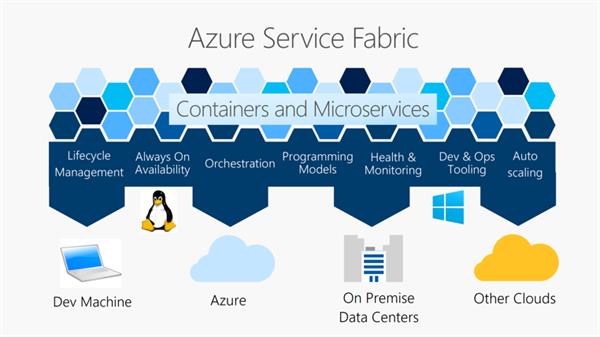
Azure Service Fabric is a distributed systems platform that makes it easy to package, deploy, and manage scalable and reliable microservices and containers. In short, fabric means a framework. Azure service fabric helps us to define loosely couple binding between microservices and its hosted infrastructure. Apps created in this environment are collected from different microservices and they communicate with each other by using service APIs. It provides a sophisticated, scalable, stateless, and stateful microservices running in containers. It also helps us to deploy, monitor, upgrade/patch, and delete deployed applications including containerized services.
The azure service provider is available in all regions. Azure service fabric runs everywhere. We can create a cluster in Azure or on-premises, on windows or Linux. Service fabric is integrated with Visual studio IDE and Power shell for windows development. Similarly, for Linux development, it is integrated with Eclipse and Yeoman.

Azure service fabric supports stateful (such as user accounts, databases, devices, shopping carts, and queues) and stateless (such as protocol gateways and web proxies) microservices. We can also create a combination of stateful and stateless microservices together.
- Reference Links –
- https://docs.microsoft.com/en-us/azure/service-fabric/service-fabric-overview
- https://azure.microsoft.com/en-in/services/service-fabric/
- https://docs.microsoft.com/en-us/azure/service-fabric/service-fabric-get-started
- https://docs.microsoft.com/en-us/azure/service-fabric/service-fabric-get-started-linux
Conclusion - In this article, we have learned the overview of Azure Service Fabric.